
AI Agent Deployment Without Vendor Lock-In
One platform. One invoice. Full control over usage, cost and AI models. How Walma helps companies scale AI agents without being locked to one vendor.

AI agents are quickly becoming part of how modern companies work. Coding agents, productivity agents, research agents and document agents can help employees move faster, automate repetitive work and get more value from company knowledge.
But for many organisations, AI agent deployment quickly becomes messy.
Different teams start using different tools. One team uses Claude Code. Another experiments with Codex. Someone else connects directly to an API. Finance receives several invoices. IT loses control over access. Management cannot see who is using what, how much it costs or whether the tools are being used in a secure and structured way.
Walma AI solves this by giving companies one platform for AI agent deployment, with central control, usage tracking, cost management and freedom to choose between different AI models.
The simple structure companies need
With Walma, AI agent deployment becomes easier to understand, manage and scale:
- 1 platform for all AI agents
- 1 invoice for all AI agent usage
- 100% visibility per employee, team and model
- 0 forced lock-in to one AI vendor or model
- Real-time control over usage, budgets and cost
This is what makes AI adoption practical at company level. Employees get access to powerful AI agents. Management gets control. Finance gets clarity. IT gets structure.
A central platform for all AI agents
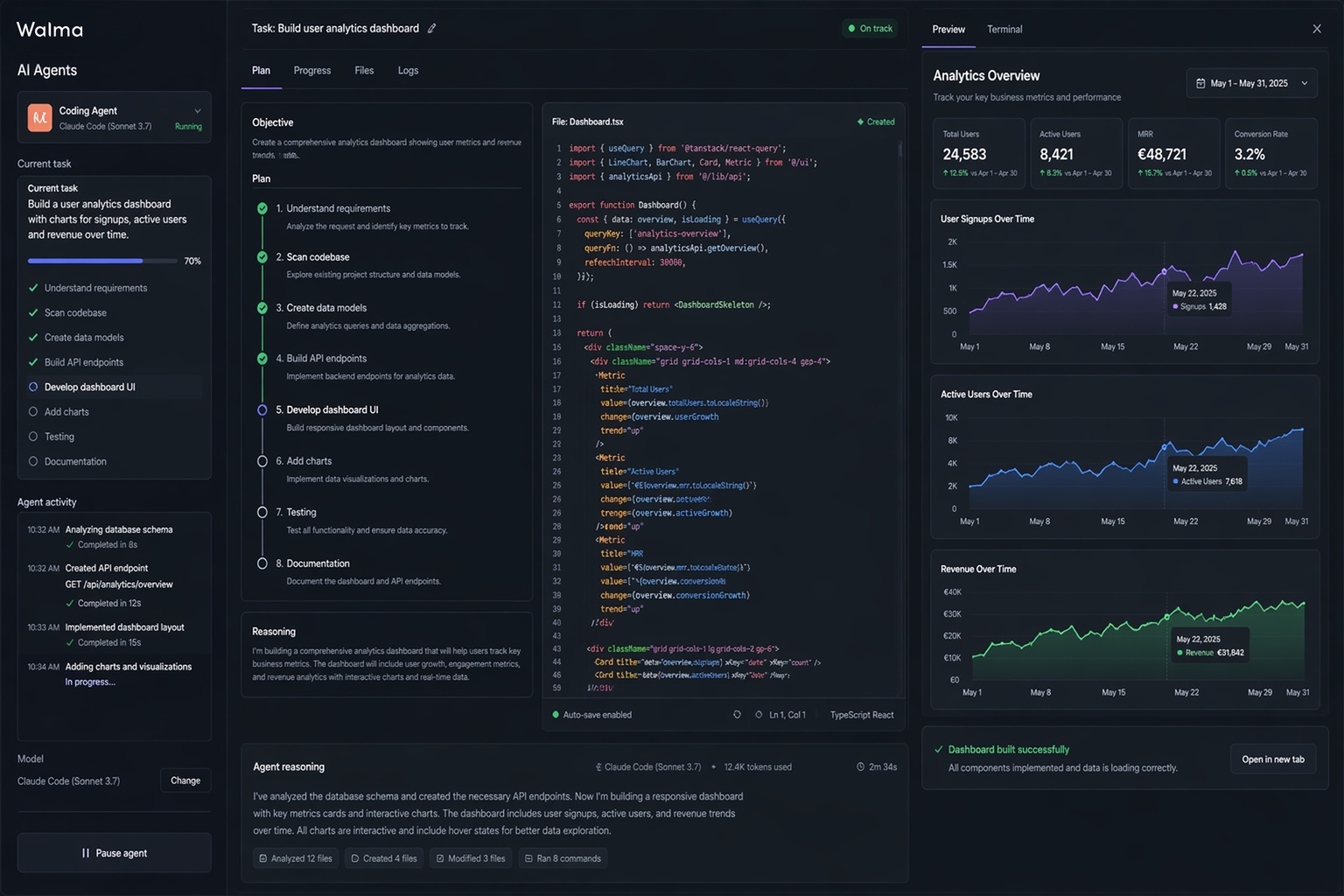
Walma AI helps companies deploy and manage AI agents across the organisation from one place.
Instead of being locked into one AI vendor, one model or one specific tool, companies can use several leading AI agents through the same structure. This can include coding agents such as Claude Code, Codex and other market-leading AI tools. The key difference is that Walma provides the layer for governance, administration and follow-up.
That means your company can deploy AI agents across teams, manage users centrally, track usage per employee, control costs before they grow, switch between AI models over time and keep one invoice for all AI agent usage.
One invoice for all AI agent usage
Managing several AI tools often creates unnecessary administration. Separate subscriptions, vendor accounts, API payments and employee licences make it harder to understand the real cost of AI across the company.
With Walma, companies get one invoice for AI agents.
This makes life easier for finance, IT and management. Instead of chasing costs across different vendors, your organisation gets one clear commercial setup for AI usage.
As AI adoption grows, this becomes increasingly important. A company may start with 5-10 users testing coding agents. A few months later, the same company may have 50 or 100 employees using agents for analysis, documentation, support, sales or internal workflows.
Without a central structure, this quickly becomes hard to manage.
With Walma, scaling AI usage does not mean scaling the administration around it.
Track AI usage per employee
One of the biggest challenges with AI agents is visibility.
Without proper tracking, it is difficult to know who is using AI tools, how often they are being used and what the actual cost is per employee or team.
Walma gives companies a central dashboard where usage can be followed per employee, team and model. This creates a clear picture of AI adoption across the organisation.
You can see which employees are using AI agents, which models and tools they are using, how much each user consumes, where costs are increasing and which teams are getting the most value from AI.
Instead of asking "Why did our AI costs increase this month?" you can ask "Which teams are using AI the most, which models are driving the cost, and where is the value being created?"
That is a much better conversation.
Control AI costs before they become a problem
Powerful AI agents can create real value, but they can also generate unpredictable costs if usage is not controlled.
Walma gives administrators the ability to manage budgets, monitor usage and set limits. This makes it possible to give employees access to advanced AI tools while still keeping cost under control.
For example, companies can set monthly budgets per user, team or model. Admins can receive alerts when usage increases and stop usage when limits are reached.
This matters because not every task requires the most powerful model. Some users may need access to advanced models for complex development work. Others may only need lighter models for everyday tasks. Walma makes that structure manageable.
Avoid vendor lock-in with flexible AI model access
The AI market changes fast. The best model today may not be the best model six months from now.
That is why companies should avoid building their entire AI strategy around one vendor.
With Walma, organisations are not tied to one AI model or one provider. Companies can switch, combine and update their AI agents as the market evolves. If a better model is released, your organisation can adapt without rebuilding the entire setup.
Instead of asking "Which model should we bet everything on?" the better question becomes "How do we build an AI structure that lets us use the best models over time?"
That is the structure Walma provides.
Secure and scalable AI agent deployment
AI agent deployment is not only about productivity. It also needs to be secure, structured and scalable.
Walma supports companies with a more controlled setup for data handling, access management and administration. The platform can be run through dedicated and regionally placed servers in Azure, with the possibility to choose region, for example within the EU, for safer and more compliant data handling.
This gives companies a stronger foundation than simply sharing API keys or letting employees create separate accounts with different AI vendors.
It also makes onboarding and offboarding easier. New users can be added through the dashboard. Access can be removed when someone leaves the company or changes role. Usage history is kept, while future access is closed.
From scattered AI tools to managed AI infrastructure
The first phase of AI adoption was experimentation. A few people tried ChatGPT. A few developers tested Claude Code. Different teams found their own tools.
That phase was useful. But it is not enough for serious company-wide deployment.
The next phase is managed AI infrastructure. That means one place to handle access, usage, cost, models, security and reporting. It means treating AI agents as a real part of the company's digital environment, not as separate tools floating around in different departments.
This is where Walma comes in.
Why companies choose Walma for AI agent deployment
Walma AI is built for companies that want to use AI agents seriously, not just test them in isolated pockets.
With Walma, your company gets:
- 1 platform for AI agent deployment
- 1 invoice for all AI agents
- 100% usage visibility per employee, team and model
- Budget control before costs grow
- Flexible access to different AI models
- No forced vendor lock-in
- Central dashboard for administration
- Secure infrastructure through Azure
- Scalable setup for teams and organisations
The result is simple: companies can give employees access to powerful AI agents while keeping control over cost, security and long-term flexibility.